



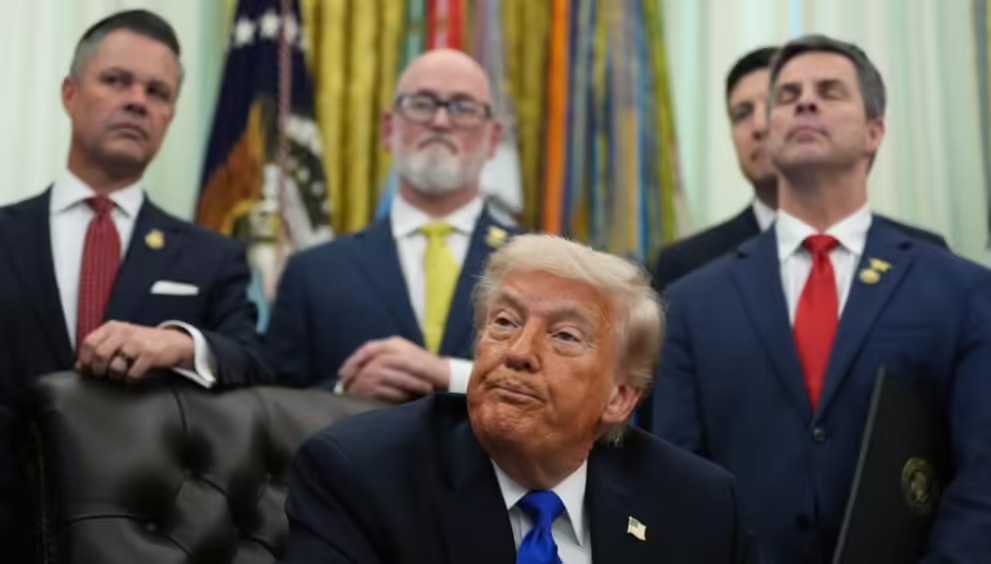
US President Donald Trump announced on Friday that he will raise tariffs on cars and trucks imported from the European Union to 25% starting next week, accusing the bloc of failing to honour a trade agreement the two sides reached last year.
Trump made the announcement in a post on Truth Social, saying the EU was not complying with the terms of what he described as a “fully agreed to” trade deal, and that the tariff on EU cars and trucks would be raised to 25%. The details on the implications of the statement are still awaited.
Background: The Turnberry agreement
The deal had been agreed upon by Trump and the European Commission President Ursula von der Leyen last July with a tariff limit of 15 percent of most EU products entering the US. The two had agreed to adhere to the structure, which was dubbed the Turnberry Agreement, named after the golf course in Scotland owned by Trump.
Early this year, the deal got into legal trouble. The Supreme Court decided that Trump did not have the legal power to declare an economic crisis and impose tariffs on EU goods under the power that he had initially invoked. This forced the administration to seek alternative legal justifications and meanwhile, the effective tariff rate was cut to 10 percent and new studies on trade imbalances and national security threats were initiated to establish a new foundation on which higher tariffs could be justified.
The latest tariff increase is expected to be imposed under Section 232 of the Trade Expansion Act of 1962, the same national security authority Trump used in March 2025 for the original 25% auto tariff.
The EU’s position
The European Commission has pushed back firmly. After the Supreme Court ruling earlier this year, the bloc issued a statement saying: “A deal is a deal. As the United States’ largest trading partner, the EU expects the US to honor its commitments set out in the Joint Statement. EU products must continue to benefit from the most competitive treatment, with no increases in tariffs beyond the clear and all-inclusive ceiling previously agreed.”
In 2024, total EU-US trade in goods and services amounted to 1.7 trillion euros with an average of 4.6 billion euros per day. The auto industry is at the core of that relationship. The initial 15 percent tariff agreement had been estimated by the EU to save European car manufacturers between 500 million and 600 million euros every month as opposed to the earlier rate of 25 percent. Going back to 25% would literally eliminate those savings.
Which automakers are most at risk
Mercedes-Benz, BMW and Volkswagen are the European auto companies that are the most vulnerable to the increase in the tariff as they import much of the vehicles they sell in the US straight off their plants in Europe.
The numbers are significant. Germany alone exported around 450,000 vehicles to the United States in 2024, a figure that has already been slipping due to earlier trade measures. Porsche and Audi face particular exposure. Porsche imports all of its US-bound vehicles from Europe, with US sales reaching around 76,000 units in 2024. Audi similarly imports all of its US sales from Mexico and Europe, and Volkswagen is currently weighing whether to shift Audi production into the US through a new facility or expansion of existing sites.
According to Oxford Economics, a 25% auto tariff would decrease German automotive exports by 7.1 percent and Italian exports by 6.6 percent, and smaller amounts would fall in Spain and France.
By 2025, Volkswagen, BMW and Mercedes-Benz had already lost a total of $6 billion to US import tariffs, and the executives of all three companies had warned that the cost might be even more this year.
Trump’s offer: Build in America
Trump made clear in his post that any automaker producing cars and trucks inside the US would be exempt from the tariff. He pointed to over $100 billion in manufacturing investments currently underway across the US, calling it a record in the history of car and truck manufacturing, and said American-staffed plants would be opening soon.
The carrot-and-stick logic is consistent with how the administration has approached tariffs across sectors — raise the cost of importing while making domestic production more attractive. US domestic production has already risen to 54.4% of all new vehicles sold in the country, as automakers like Toyota and Stellantis have invested billions in US facilities in response to earlier trade pressure.
What’s next
The announcement comes at a delicate moment for the global economy. US-Iran tensions, elevated crude prices, and the ongoing disruption to shipping through the Strait of Hormuz have already rattled financial markets in recent weeks. Adding a sharp escalation in transatlantic trade friction to that backdrop adds another layer of uncertainty.
Markets will be watching closely for the EU’s formal response in the coming days, and whether Brussels moves to retaliate or seeks a fresh round of negotiations. Given that the original Turnberry Agreement was reached relatively quickly when both sides were motivated to strike a deal, a negotiated resolution is possible. Whether that happens before the tariffs take effect next week is another question entirely.


