



UAE energy minister says exit is a strategic move.
April 29, 2026: The United Arab Emirates will be quitting the Organisation of Petroleum Exporting Countries (OPEC) on May 1, ending a 60-year membership. The move, confirmed by the UAE’s official news agency on Tuesday, leaves one of the bloc’s most significant members at a moment when global oil markets are already on edge due to the conflict between the US-Israeli alliance and Iran.
The UAE’s withdrawal follows years of simmering tensions with OPEC’s dominant player, Saudi Arabia, over oil production policy and regional political influence. It also withdraws from the broader OPEC+ alliance.
Why Now
The timing seems to be deliberate. UAE Energy Minister Suhail Al Mazrouei said the war provided a “good timing”. The reason is simple: the shut-down of the Strait of Hormuz will mean the immediate impact on oil prices and exports will be minimised, allowing the UAE to make a decisive break without immediately threatening markets or exports.
The war has badly impacted the Strait of Hormuz, through which almost a fifth of global oil and gas was previously shipped. Prior to February, at least 130 vessels were navigating the strait each day, but on Wednesday morning only six ships were trying to transit.
The UAE has been unhappy with its quota as an OPEC member for some time. It is one of the bloc’s biggest producers but it also has a lot of spare capacity – the amount of oil it could be producing but isn’t. By withdrawing from the cartel, the UAE will be able to produce more oil and earn more profit.
The UAE’s increasingly muscular foreign policy has increasingly distanced it from other OPEC members, particularly Saudi Arabia, which shares its concerns about the UAE’s stance on Yemen and other issues. Abu Dhabi has been asserting its own influence in the Middle East and Africa, and has been strengthening its ties with the United States and Israel, with which it signed the 2020 Abraham Accords.
OPEC has 12 members, which are Algeria, Republic of the Congo, Equatorial Guinea, Gabon, Iran, Iraq, Kuwait, Libya, Nigeria, Saudi Arabia and Venezuela. The UAE’s withdrawal means the bloc is losing a member with a capacity of 4.8 million barrels per day.
What’s Next for Oil Production
The UAE’s exit from OPEC is likely to result in increased production. The UAE’s official news agency said that after exiting OPEC, it will “continue to act responsibly, bringing additional production to market in a gradual and measured manner, aligned with demand and market conditions”.
Jorge Leon, head of geopolitical analysis at Rystad Energy, said the UAE “can increase production rapidly” and will “just act as a normal non-OPEC producer where they just pump as much as they can”. All this would not occur overnight, because of the Strait of Hormuz issue, but once the crisis passes, it could have a big impact on the oil markets.
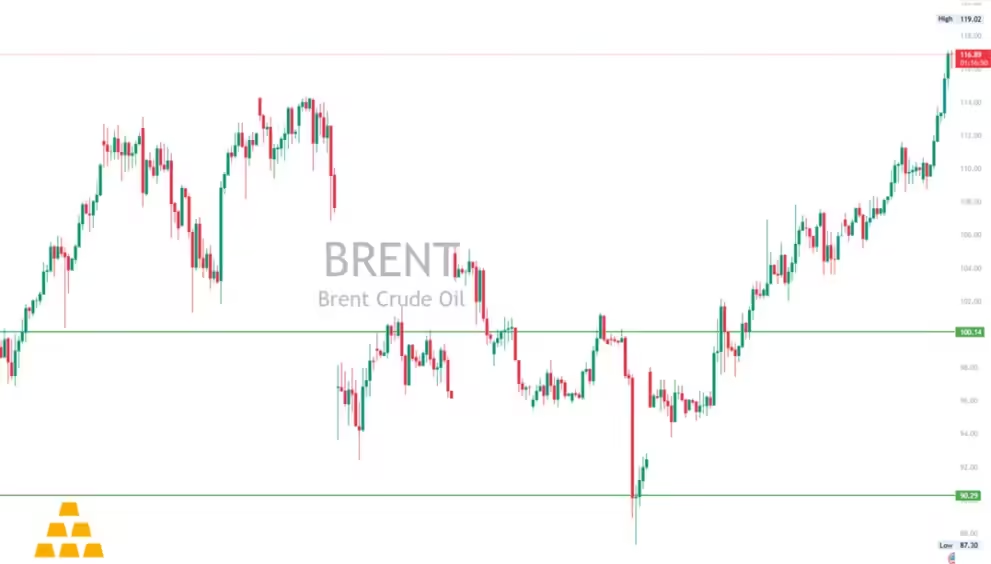
Crude oil in the US hit $100 a barrel for the first time since April 10 following the failure of Iran peace talks and the UAE’s announcement to withdraw from the OPEC oil cartel. The West Texas Intermediate oil price climbed to almost $102 per barrel in early trading. Brent, the international benchmark, also spiked to almost $115 per barrel. The US national average price for a gallon of gasoline also reached its highest this year at $4.18.
The Broader Signal
Jorge Leon, an analyst for Rystad, said the UAE’s decision “is a major development in OPEC” and that “while short-term consequences may be limited due to the current disruption in the Strait of Hormuz, the long term effect is a weaker OPEC.”
Ahmed Helal from the advisory firm The Asia Group said that the UAE and Saudi Arabia are the two largest economies in the Gulf, and the fallout between the two could have an impact on unity among Arab nations in the Gulf region, “with a lasting effect on regional security coordination and cross-border business”.
What It Means for India
India is a major crude oil importer, and the Gulf region provides most of its oil needs. The UAE is a key trading partner. A UAE not bound by OPEC production constraints, able to increase its production once the Strait of Hormuz opens up, could potentially lead to an increase in oil supply and lower prices in the medium term.
In the meantime, with the strait closed, Indian refiners are contending with tight supplies and high prices. The oil marketing companies (Indian Oil, BPCL and HPCL) have been contending with higher input costs and any price above $100 a barrel for an extended period will negatively impact the current account deficit and the macro economy.
The situation remains fluid. Negotiations between the US and Iran continue, and the course of the war and the oil price will be largely determined by the reopening and timing of the Strait of Hormuz.

