



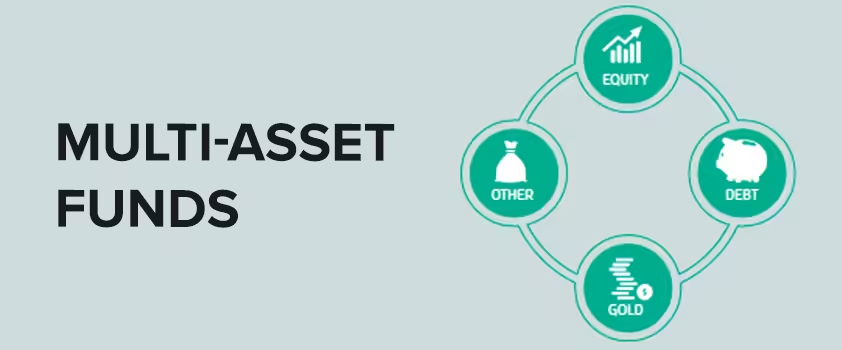
Amidst the rising global market volatility, investors can turn to multi-asset funds that provide potential for stable, long-term wealth creation with balanced risk structure.
Don’t put all your eggs in one basket! Extreme market volatility is when investors actually understand the weight of this quote. No asset class performs consistently well across market cycles. Nor do they all move in the same direction in a single cycle.
With the Nifty 50 delivering largely flat returns over the past year and equity markets staying choppy through early 2026, a growing number of people are finding a home in Multi-Asset Allocation Funds. The numbers tell the story clearly. In the first quarter of 2026, geopolitical tensions and rising crude prices triggered choppy equity markets, pushing investors toward relatively stable, diversified vehicles. MAAFs recorded a record monthly inflow of Rs 10,485 crore in January 2026, while 12-month inflows stood at Rs 61,666 crore, marking a Rs 25,869 crore year-on-year increase.
For investors, the challenge has always been managing the trade-off between assets. Allocating across asset classes requires not only an understanding of each segment but also the discipline to rebalance at the right time. This is where multi-asset allocation funds have gained relevance, especially in periods of heightened market volatility. In volatile markets, multi-asset funds offer stability by simultaneously spreading investments across equities, debt, and gold.
What are multi-asset funds?
Multi-asset allocation funds invest in multiple asset classes, with the minimum being three. These funds require a minimum of 10% allocation to each, as mandated by SEBI regulations. Beyond that floor, fund managers have the freedom to tilt allocations based on where they see opportunity or risk. Generally, these funds blend equity for growth, debt investments for stability and commodities such as gold for inflation protection.
The primary focus, therefore, is genuine diversification across uncorrelated assets. This is different from aggressive hybrid funds limited to equity + debt since multi-asset funds should definitely include a third asset class. The logic is straightforward. Each asset class responds differently to market conditions. When equities face challenges, debt provides stability, and gold often rises during times of uncertainty. This structured mix helps the fund perform reliably in various market conditions. Fund managers actively monitor market trends and economic indicators to adjust the asset allocation, maintaining the right balance between risk and return.
The multi-asset funds category in India is dominated by ICICI Prudential Multi Asset Allocation Fund (₹ 77,658 Cr AUM) managed by Sankaran Naren, followed by SBI Multi Asset Allocation Fund (₹ 16,150 Cr AUM), and Nippon India Multi Asset Allocation Fund (₹ 13,139 Cr AUM).
Also Read: FM Sitharaman Chairs Meeting On Mythos Impact On India’s Fintech Ecosystem
Significance of smart diversification
Global factors such as rising interest rates, inflation concerns, and geopolitical tensions have created an environment where different asset classes are reacting in divergent ways. Equity markets have seen intermittent volatility, debt markets have adjusted to higher yield expectations, and gold has gained immense traction as a hedge against uncertainty.
Sandeep Tandon of Quant Mutual Fund says multi-asset funds will become the largest category in the investment landscape over the next 10 to 20 years, offering substantial long-term wealth creation opportunities.
The confidence is backed by recent flows. Multi-asset funds saw an inflow of Rs 7,425.98 crore in December 2025 alone as investors looked for safety amid market swings. Weak equity performance made gold and debt allocations useful in limiting losses.
In addition, this investment option offers over 50 funds that collectively manage more than ₹3 lakh crore. Such a figure is a clear indication of strong retail adoption amid market fluctuations.
In this category of funds, rebalancing for consistent diversification becomes the core focus for professional managers, making multi-asset funds ideal for investors seeking growth with lower risk than pure equity.
Also Read: RBI Cracks Down On Mis-Selling At Bank Counters: Refunds, Consent Rules & Dark Pattern Ban
Is this for you?
These funds are well-suited for systematic withdrawal plans and retirement strategies, blending growth, stability and hedging in one vehicle. Across investor profiles, from beginners to aggressive investors and retirees, multi-asset funds are steadily carving out a central role, reflecting a broader shift toward disciplined diversification and smoother compounding. For investors with a moderately aggressive risk profile, multi asset allocation funds may be a good option to explore – higher than pure debt but lower risk than pure equity investments.
Of course, as with any market investments, it is prudent to conduct thorough due diligence and consult a certified financial advisor based on one’s goals, investment horizon, and risk profile before investing in any fund, to ensure that investment decisions are backed by solid professional guidance rather than just hearsay.

