


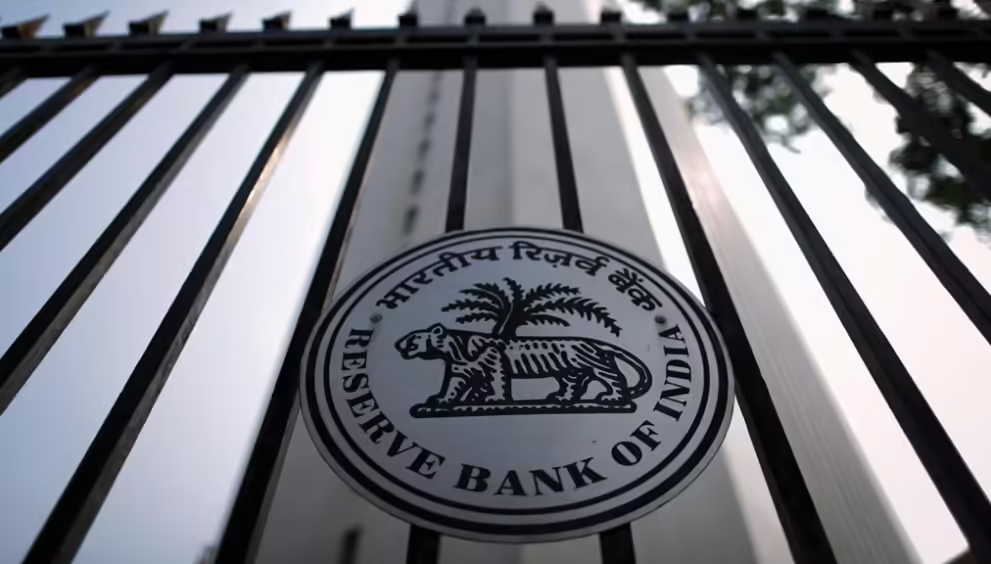
RBI tightens mis-selling norms, mandates refunds, bans dark patterns, reshapes bank product distribution accountability.
India’s banking regulator has moved decisively to redraw the boundaries of financial product distribution. The Reserve Bank of India (RBI) has released sweeping draft guidelines under its proposed Responsible Business Conduct Framework, targeting long-standing concerns around mis-selling, coercive cross-selling, bundled products, and deceptive digital practices.
The draft norms, open for public comments until March 4 and scheduled to come into force from July 1 – mandate explicit customer consent, suitability checks, compensation for mis-selling, and tighter oversight of sales incentives and third-party distribution.
The move follows repeated regulatory warnings that aggressive selling practices, particularly of insurance and investment products, were eroding consumer trust within the banking ecosystem.
Formal Definition of Mis-Selling Introduced
For the first time, RBI has provided a structured regulatory definition of “mis-selling.” The draft framework classifies the following as violations:
– Selling products unsuitable for a customer’s financial profile
– Providing misleading or incomplete product disclosures
– Selling without explicit customer consent
– Compulsory bundling of financial products
Suitability will now be assessed using parameters such as age, income, financial literacy, and risk appetite, placing accountability squarely on banks before recommending third-party or proprietary offerings.
Explicit Consent Becomes Mandatory
The RBI defines explicit consent as a specific, informed, and unambiguous indication of agreement, which must be formally documented and stored by the bank in auditable form. This could include digital consent logs, recorded telephonic confirmations, video KYC-style acknowledgements, or physically signed declarations, all of which must be retrievable for regulatory inspection and grievance resolution.
Importantly, consent cannot be bundled or clubbed across products. Each product – be it insurance, mutual funds, structured deposits, credit cards, or add-on services, must receive independent, product-level approval from the customer. Pre-ticked checkboxes, blanket declarations, or omnibus consent formats will not qualify as valid authorization under the draft norms.
Operationally, this will require banks to overhaul onboarding journeys, redesign consent architecture within mobile and internet banking platforms, and train frontline staff to follow suitability-led advisory rather than incentive-driven selling.
From a compliance standpoint, explicit consent records will now form a critical part of internal audits, RBI supervisory reviews, and dispute resolution mechanisms making mis-selling far easier to detect, attribute, and penalize.
Full Refunds and Compensation for Mis-Selling
The draft rules introduce one of the strongest consumer protection clauses seen in India’s banking distribution ecosystem to date, fundamentally altering the risk calculus around product mis-selling.
If mis-selling is established, either through customer complaints, internal audits, or regulatory reviews, banks will be obligated to:
– Refund the entire product amount paid by the customer
– Compensate for any financial loss arising from the mis-sold product
This includes not only the principal invested but also associated charges, commissions, penalties, or opportunity losses, wherever applicable.
The framework effectively transforms mis-selling from a reputational and regulatory concern into a direct financial liability on bank balance sheets. This creates strong internal compliance incentives, pushing banks to reassess frontline sales practices, incentive structures, and third-party distribution partnerships.
To institutionalize accountability, the RBI has mandated that banks must:
– Seek structured customer feedback within 30 days of product sale
– Track satisfaction, suitability understanding, and disclosure adequacy
– Compile half-yearly sales conduct reports for internal and regulatory review
These reports must highlight complaint trends, refund cases, disciplinary actions, and corrective training measures.
From a governance perspective, boards will be required to oversee compensation frameworks and grievance redressal timelines, ensuring mis-selling cases are resolved transparently and within defined service standards.
Over time, this could materially alter fee-income models for banks, particularly those heavily reliant on insurance and third-party investment distribution.
Ban on Dark Patterns in Banking Apps
Extending regulatory scrutiny into the digital banking ecosystem, the RBI has explicitly targeted the use of “dark patterns” manipulative user-interface design practices that influence or coerce customers into unintended financial decisions.
Dark patterns typically exploit behavioral biases, nudging users toward product purchases, consent approvals, or paid upgrades without fully transparent disclosures.
Illustrative practices identified by the RBI include:
– Pre-ticked consent boxes for add-on services or insurance
– Hidden charges revealed only at final transaction stages
– False urgency prompts such as limited-time offers or expiring deals
– Complex or obstructive cancellation processes
Under the draft framework, banks must ensure that all digital interfaces – including mobile apps, internet banking portals, and product microsites, adhere to fair, transparent, and user-consent-driven design principles.
Institutions will be required to conduct periodic UI/UX audits, either internally or via independent reviewers, to certify that customer journeys remain free from manipulative nudges.
This marks a significant regulatory evolution, acknowledging that mis-selling risks have migrated from physical bank counters to digital onboarding and self-service ecosystems.
As digital banking adoption accelerates, especially among retail and first-time investors, ethical interface design becomes central to consumer protection. The RBI’s move signals that regulatory oversight will now extend beyond financial disclosures into the behavioral architecture of banking technology itself.
Government & Regulatory Pressure Behind the Move
The RBI’s draft framework does not emerge in isolation, it reflects mounting, multi-layered institutional concern around the scale and persistence of product mis-selling across India’s financial ecosystem.
Over the past few years, regulators and policymakers have repeatedly flagged aggressive distribution practices particularly through bank branches as a structural risk to consumer protection and financial trust.
One of the most pointed observations came from the Economic Survey FY24, which described mis-selling as “too rampant to dismiss as an aberration of a few overenthusiastic sales personnel.” The Survey warned that short-term fee income pursuits were increasingly being prioritized over customer suitability and long-term financial well-being.
Parallelly, the Finance Ministry’s Department of Financial Services (DFS) has issued directives asking banks and non-bank lenders to reassess their product distribution frameworks. A key recommendation has been the delinking of insurance sales from employee incentive structures, aimed at curbing coercive or target-driven selling behavior at branch counters.
The insurance regulator, IRDAI, has echoed similar concerns. Senior officials have urged banks to refocus on core lending and deposit functions rather than aggressively pushing insurance policies as fee-income drivers. Policymakers have also flagged instances where mis-sold insurance products indirectly increased customers’ borrowing costs.
Despite these pressures, the RBI has clarified that it does not intend to restrict the bancassurance model a key channel for insurance penetration and financial inclusion. Instead, the regulator’s approach is to strengthen safeguards without disrupting distribution architecture, ensuring suitability, transparency, and accountability remain central to product sales.
In essence, the framework represents a coordinated regulatory shift moving the industry from sales-led growth to responsibility-led distribution.
Sales Incentives & Agent Oversight Tightened
Another structural pillar of the draft framework is the tightening of sales incentive architectures and third-party distribution oversight two areas regulators believe sit at the heart of mis-selling risk.
Historically, frontline banking staff and outsourced agents have operated under volume-linked incentive structures, where higher commissions were tied to pushing insurance, wealth, and investment products often irrespective of customer suitability.
The RBI’s draft now explicitly discourages compensation models that reward aggressive selling behavior over responsible advisory conduct.
To strengthen accountability across outsourced channels, banks must now:
– Publish and regularly update lists of Direct Selling Agents (DSAs) and Direct Marketing Agents (DMAs)
– Ensure all such agents undergo formal training and certification
– Maintain verifiable conduct and suitability records
– Clearly distinguish agents from full-time bank employees within branch premise
This distinction is critical. Many past complaints arose from customers assuming third-party agents were official bank relationship managers, leading to misplaced trust in product recommendations.
Banks will now be required to implement internal monitoring frameworks covering:
– Agent sales scripts and disclosures
– Incentive payout structures
– Customer grievance linkage
– Periodic conduct audits
The shift effectively extends regulatory supervision beyond bank balance sheets into the broader financial distribution ecosystem.
By tightening agent governance, the RBI aims to plug conduct risks at the last mile where product advice meets retail capital.
Market & Industry Implications
The proposed framework carries meaningful implications for banking revenue models, insurance distribution economics, and third-party product ecosystems.
For banks, one immediate impact could be moderation in fee-based income streams, particularly from high-margin insurance and wealth product distribution.
Over the past decade, non-interest income including bancassurance commissions, mutual fund distribution fees, and structured product sales has become a key profitability lever, especially amid tightening lending spreads.
Stricter suitability norms, recorded consent requirements, and post-sale audits could:
– Slow cross-selling velocity
– Increase product rejection rates
– Extend sales conversion cycles
Simultaneously, compliance costs are set to rise. Banks will need to invest in:
– Sales surveillance system
-Consent recording infrastructure
– UI/UX redesigns for digital journeys
– Staff retraining programs
– Half-yearly regulatory reporting
While this raises near-term operating expenses, it could strengthen long-term franchise value.
Improved transparency and reduced conduct risk may enhance.
For insurers and asset managers heavily reliant on bank distribution channels, the impact could be structural.
They may need to recalibrate go-to-market strategies toward:
– Need-based selling frameworks
– Simplified product disclosures
– Lower upfront commissions
– Higher trail-based compensation models
In essence, the guidelines signal a broader industry pivot from commission-maximization to customer-suitability economics.
Distribution will likely become slower, but more durable.
Conclusion
RBI’s draft mis-selling framework marks a structural shift from sales-led banking to responsibility-led distribution. By mandating explicit consent, banning dark patterns, enforcing refunds, and tightening agent oversight, the regulator is prioritizing customer trust over short-term fee income.
While banks may face near-term revenue and compliance pressures, the long-term outcome is clear, a more transparent, accountable financial ecosystem. For investors and consumers alike, this move strengthens systemic credibility and reinforces ethical conduct at the heart of India’s banking system.