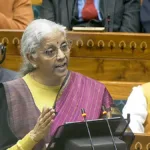



Finance Minister Nirmala Sitharaman presented Budget 2026, focusing on economic growth with measures like increased capital expenditure to ₹12.2 lakh crore for FY27 and initiatives for high-speed rail and regional medical hubs.
Presenting her ninth consecutive budget on Sunday, February 1, Finance Minister (FM) Nirmala Sitharaman made several key announcements, aimed at accelerating and sustaining economic growth, aligned with the vision of ‘Sabka Sath Sabka Vikas’.
The FM outlined several measures, ranging from a capex hike to high-speed rail corridors to regional medical hubs.
Moreover, the FM announced that the Income Tax Act, 2025, will come into effect from 1st April, 2026.
“The simplified income tax rules and forms will be notified shortly, giving adequate time to taxpayers to acquaint themselves with their requirements,” said the FM.
Let’s take a look at 10 key takeaways from Finance Minister Nirmala Sitharaman’s budget speech:
Budget 2026: Key takeaways
1. Capex hike
The FM kept growth in focus and raised the government capex target slightly.
Highlighting the sustained increase in government capital expenditure (capex) over the years, the FM proposed to increase the government capex to ₹12.2 lakh crore for FY27 from ₹11.2 lakh crore in FY26.
“Public capex has increased manifold from ₹2 lakh crore in FY14-15 to an allocation of ₹11.2 lakh crore in BE 2025-26. In FY2026-27, I propose to increase it to ₹12.2 lakh crore to continue the momentum,” said the FM.
According to Crisil, the ₹12.2 lakh crore budget outlay for capital expenditure marks an 8.9% increase over the current fiscal and is in line with expectations, but lower than the likely need.
Also Read | Budget 2026: FM Nirmala Sitharaman Announces STT Hikes Of Up To 150% On F&O
2. Focus stays on fiscal consolidation
For FY27, the budget estimate of the fiscal deficit is 4.3% of GDP, while the revised estimate for FY26 is 4.4%.
“In RE 2025-26, the fiscal deficit has been estimated at par with the BE (budget estimates) of 2025-26 at 4.4% of GDP. In line with the new fiscal prudence path of debt consolidation, the fiscal deficit in BE 2026-27 is estimated to be 4.3% of GDP,” said the FM.
The FM projected the debt-to-GDP ratio to be 55.6% of GDP in BE 2026-27, compared with 56.1% in RE (revised estimates) 2025-26.
Moreover, the FM announced that the net market borrowings from dated securities are estimated at ₹11.7 lakh crore. The balance financing is expected to come from small savings and other sources. The gross market borrowings are estimated at ₹17.2 lakh crore.
Basant Bafna, the head of fixed income at Mirae Asset Investment Managers (India), highlighted that the net market borrowing at ₹11.7 lakh crores is broadly in line with market expectations with the government scoring on its commitment to fiscal consolidation with fiscal deficit budgeted to fall to 4.3% in FY27 from 4.4% in FY 2026 under the broader goal of achieving Debt to GDP ratio of 50 ± 1% by FY 2030-31.
3. Seven new high-speed rail corridors
The FM proposed adding seven high-speed rail corridors: Mumbai to Pune, Pune to Hyderabad, Hyderabad to Bengaluru, Hyderabad to Chennai, Chennai to Bengaluru, Delhi to Varanasi, and Varanasi to Siliguri, with the aim of promoting environmentally sustainable passenger travel.
Also Read: Budget 2026 Makes It Easier For NRIs To Invest In India
4. Measures to strengthen bond markets
The FM proposed a market-making framework with access to funds and derivatives on corporate bond indices. The move is aimed at strengthening the corporate bond market.
“To encourage the issuance of municipal bonds of higher value by large cities, I propose an incentive of ₹100 crore for a single bond issuance of more than ₹1000 crore. The current scheme under AMRUT, which incentivises issuances up to ₹200 crore, will also continue to support smaller and medium towns,” said the FM.
5. Focus on banking for the Viksit Bharat goal
The FM said a high-level committee on banking will be set up for Viksit Bharat. The FM said the committee will review the entire banking system and suggest changes to support India’s next stage of economic growth.
“I propose setting up a high-level committee on banking for Viksit Bharat, to comprehensively review the sector and align it with India’s next phase of growth, while safeguarding financial stability, inclusion and consumer protection,” said the FM.
Also Read: Budget 2026: Gen Z’s Playbook For The Future
6. NRIs’ investment limit increased
The investment limit for NRIs was increased from 5% to 10% and the overall investment limit was increased to 24% from 10%.
The move is expected to enable greater participation of NRI capital and improve access to long-term overseas funds.
“Increased flexibility for such investments can also support market liquidity and price discovery. Going forward, continued reforms in this space would be welcome, as further clarity and calibrated liberalisation can play a key role in boosting foreign investment inflows into India,” said Moin Ladha, Partner at Khaitan & Co.
“Individual persons resident outside India will be permitted to invest in Indian equities through the portfolio investment scheme with higher limits. These increases enable foreign investors to build more substantial positions in Indian companies, which could enhance market efficiency, broaden the shareholder base, and foster stronger long-term investment in Indian capital markets,” said Tanvi Kanchan, Associate Director & Head – NRI Business, Anand Rathi Share and Stock Brokers Limited.
7. Taxes on STT increased
The FM proposed to increase the securities transactions tax (STT) by more than 50% on futures to 0.05% from 0.02% and to 0.15% from 0.01% earlier on options transactions.
“I propose to raise the STT on Futures to 0.05% from the present 0.02%. STT on options premium and exercise of options are both proposed to be raised to 0.15% from the present rate of 0.1% and 0.125%, respectively,” the FM said in her budget speech.
Also Read: FM Nirmala Sitharaman Announces STT Hikes
8. Push for medical tourism services
The FM proposed launching a scheme to support states in establishing five regional medical hubs, in partnership with the private sector, to promote India as a hub for medical tourism services.
“These Hubs will serve as integrated healthcare complexes that combine medical, educational and research facilities. They will have AYUSH centres, medical value tourism facilitation centres and infrastructure for diagnostics, post-care and rehabilitation. These Hubs will provide diverse job opportunities for health professionals, including doctors and AHPs,” said the FM.
9. Centre to give ₹1.4 lakh crore to the States as as Finance Commission Grants
The FM, in the budget speech, highlighted that the government has accepted the recommendation of the 16th Finance Commission to retain the vertical share of devolution at 41%.
“As recommended by the Commission, I have provided ₹1.4 lakh crore to the States for the FY 2026-27 as Finance Commission Grants. These include rural and urban local body and disaster management grants,” said the FM.
Also Read: Govt Makes It Easier For NRIs To Invest In India
10. Tax holiday for cloud service providers
Emphasising the need to support critical infrastructure and boost investment in data centres, the FM proposes to provide a “tax holiday till 2047 to any foreign company that provides cloud services to customers globally by using data centre services from India.
“It will, however, need to provide services to Indian customers through an Indian reseller entity,” the FM added.