



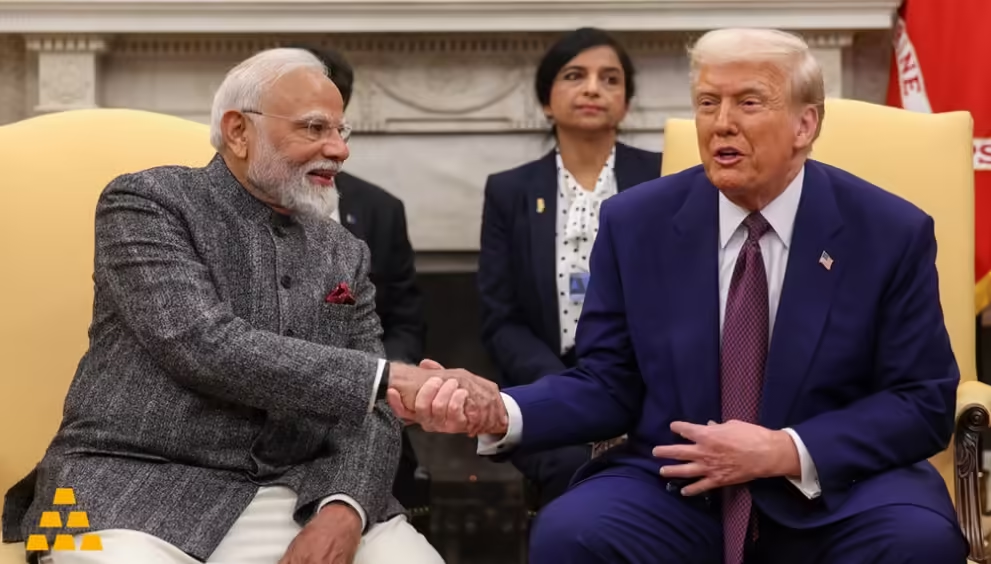
India-US trade thaw sparks a global risk-on rally, as markets reprice reduced uncertainty rather than immediate growth.
Global markets witnessed a sharp risk-on move after news broke of renewed trade engagement between India and the United States following talks between Prime Minister Narendra Modi and US President Donald Trump. The immediate reaction was swift and decisive: US equity markets surged, Asian risk assets firmed up, and GIFT Nifty jumped nearly 3%, signaling a strong gap-up opening for Indian equities.
While headlines were noisy and politically charged, markets focused on one core theme: de-risking of the India–US trade relationship.
What Is Officially Confirmed?
From India’s side, Prime Minister Modi confirmed positive and constructive trade discussions with the United States, with emphasis on:
1. Tariff rationalisation.
2. Expansion of bilateral trade
3. Long-term economic and strategic cooperation
Crucially, India has not officially confirmed any commitment to halt Russian oil imports, despite claims made by the US administration. Markets, however, largely ignored the geopolitical angle and instead priced in what was clearly visible: easing trade friction between the world’s largest economy and one of the fastest-growing major economies.
In markets, certainty matters more than narratives, and the signal of improved trade dialogue itself was enough to trigger a relief rally.
Why Markets Reacted So Strongly?
The Indian market’s sharp reaction is rooted in risk premium compression rather than immediate earnings changes.
Over the past year, Indian equities had been carrying a mild “policy overhang” related to:
1. US tariff actions on Indian exports
2. Uncertainty around future trade terms
3. Broader geopolitical pressure linked to energy and strategic autonomy
The announcement of renewed engagement effectively removed a key tail risk. When such binary risks fade, markets tend to reprice quickly.
In short, markets were not celebrating growth acceleration, they were celebrating reduced uncertainty.
Also Read: Budget 2026 Snapshot: Top 10 Takeaways By Daily Equity
Implications for Indian Equity Markets
1. Sentiment Shift: Risk-On Mode Activated
The immediate impact is psychological. Indian equities enter the session with:
– Improved global cues
– Positive offshore signals
– Strong FII sentiment setup
This increases the probability of:
– Gap-up opening
– Short-covering in index heavyweights
– Momentum continuation in the first half of the session.
However, gap-ups driven by global news often invite intraday volatility, especially near resistance levels.
Also Read: Budget 2026: FM Nirmala Sitharaman Announces STT Hikes Of Up To 150% On F&O
2. Sectoral Impact: Who Benefits Most?
Export-oriented sectors stand out as clear near-term beneficiaries:
– IT services: Lower trade friction improves revenue visibility from the US, India’s largest tech market
– Pharma: Tariff rationalisation reduces regulatory and pricing uncertainty
– Textiles & specialty manufacturing: Improved competitiveness in US markets Banks and financials may benefit indirectly through improved FII inflows, better overall market liquidity and stronger risk appetite.
Meanwhile, oil marketing companies and energy-sensitive sectors may see mixed reactions, given the lack of clarity around India’s actual energy procurement policy.
Also Read: Budget 2026: Growing India’s Corporate Bond Market
Bottom Line
The India-US trade update has triggered a classic risk-on repricing, driven by reduced uncertainty rather than immediate economic gains. Indian markets are set for a strong start, supported by global cues and offshore signals.
However, the real test lies ahead. Markets have given policymakers the benefit of the doubt, now they will demand delivery.
For investors, the message is clear: Respect the momentum, but anchor decisions in execution, not headlines.

