



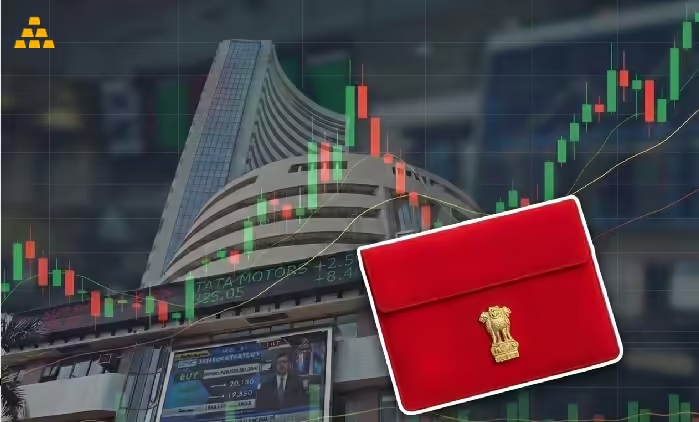
Budget cues to drive market swings this Sunday, 1st February 2026, as the investors react to Budget announcements in real time. Rare Sunday session puts Budget impact in sharp focus.
In an exceptional departure from standard practice, Indian stock exchanges including the National Stock Exchange (NSE) and the Bombay Stock Exchange (BSE) will remain open for a full trading session on Sunday, February 1, 2026, coinciding with the presentation of the Union Budget 2026-27 by Finance Minister Nirmala Sitharaman. This marks only the second time in independent India’s history that the equity markets will operate on a Sunday.
Why Is The Stock Market Open On Sunday?
Typically, Indian equity and commodity markets observe a weekend holiday, closed on Saturdays and Sundays, with trading resuming on Monday. However, when the Union Budget presentation falls on a weekend, exchanges have, in recent years, made special arrangements to keep markets live to allow real-time reactions to the policy announcements.
For 2026, the Budget speech is scheduled at 11 am on Sunday, and stock exchanges will be open throughout the day on regular market hours:
• Pre-open session: 9:00 am – 9:08 am
• Normal trading: 9:15 am – 3:30 pm
• Trade modification: till 4:15 pm
Investors and traders will have the opportunity to buy, sell and adjust positions in real time as fiscal measures are announced, helping reduce uncertainty that can build up over a market holiday.
A Rare Historical Occurrence
This is not the first occasion the markets have opened when the Budget falls on a weekend, but such events are few and far between.
The last Sunday trading session linked to a Budget occurred on February 28, 1999, when the market was opened to allow immediate price discovery as then-Finance Minister Yashwant Sinha presented the Budget.
In recent decades, the Budget has sometimes fallen on Saturdays and exchanges opened accordingly for example, during the Budget presentations on weekend dates like February 1 in years past.
Despite these rare exceptions, Sunday trading remains a notable anomaly in the typical financial calendar.
What This Means for Investors?
Opening markets on Budget day transforms what might be a symbolic policy announcement into an active trading event.
Analysts and traders will be watching key sectors such as banking, infrastructure, defence, and consumption for immediate reactions to fiscal incentives, tax changes, spending priorities, or growth-oriented measures.
While historical data suggests that market moves on Budget day itself are often muted, the post-Budget week has tended to show larger trends.
For example, data over the past decade shows that the broader market index saw minimal average movement on Budget day, but more significant performance in the days after the announcements as investors digest implications.
Commodity exchanges such as the Multi Commodity Exchange (MCX) and NCDEX will also operate on the same day with special live trading sessions to ensure uninterrupted trading in gold, silver, energy and agricultural contracts.
Wider Context: Budget Expectations
The decision to open markets on Sunday aligns with the growing importance of the Union Budget as a policy event that COVID-era market participants increasingly monitor closely. With capital flows sensitive to fiscal policy direction, real-time trading during the Budget presentation helps global and domestic investors react without waiting for the next working day.
As the markets brace for Budget 2026’s impact, this rare Sunday session underscores both the significance of fiscal policy in market dynamics and the flexibility of Indian exchanges in adapting trading calendars for landmark economic events.

